
Why does Mayank Yadav’s bowling look so effortless?
By Manas Patil
The mechanics behind Mayank Yadav’s ability to generate express pace without appearing to force the delivery.
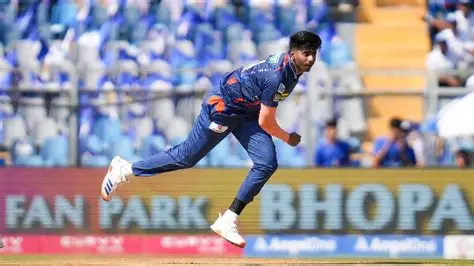
Mayank Yadav has emerged as one of India’s fastest bowlers. He is an express pace bowler from Delhi, who had played just two List A games when he was picked by Lucknow Super Giants in IPL 2022. He did not play a match in his first season and was ruled out of the next season due to a hamstring injury. He made his IPL debut in 2024 against Punjab Kings in Lucknow, where he consistently hurried batters with his pace. He picked up 3 for 27 from his four overs and recorded a top speed of 155.8 kmph. He went one notch better in his second game against Royal Challengers Bengaluru, clocking up to 156.7 kmph, the fastest ball recorded in the IPL 2024. He consistently breached the 150 kmph speed barrier and finished with 3 for 14 from his four overs. He became the first player in the history of IPL to win the Player of the Match award in the first two matches.
Decoding His Bowling Action
The rhythmic Run-up :
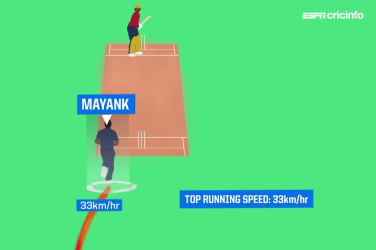
Mayank Yadav is a side-on hip dominant bowler who relies mostly on run-up momentum to deliver the ball. He is known for his highly repetitive rhythmic run-up, with a gradual increase in stride length and speed. He achieves his top speed of 33kmph just before the jump, allowing him to carry the maximum generated horizontal momentum into the action.
The Impulse Stride :
Impulse stride also known as penultimate stride is the final stride before the bowler jumps. It links up the run-up to the jump, helping transfer the run-up momentum through the impulse stride into the jump. Mayank Yadav not just transfers the momentum effortlessly but also applies maximum force towards the batter through the impulse stride. The amount of force applied into the ground before his jump is clearly evident in his flexed left foot.
Forward Jump with Shin Lead :
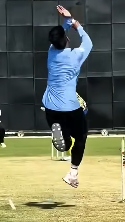
He loads up in front of his body before moving into a combination of high and forward jump, predominantly a forward jump. This forward jump helps him to efficiently transfer all the horizontal momentum towards the batter. This reduces the amount of momentum lost vertically or during the transition into the delivery.
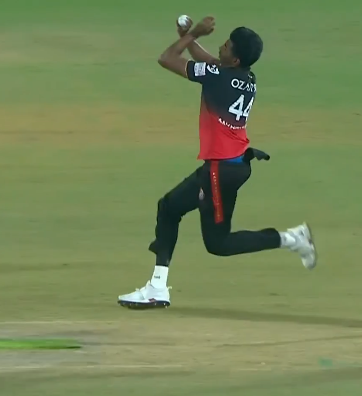
Shin lead is the position where the bowler leads with his backleg’s shin. This is the sign of an efficient transfer of horizontal momentum in forward direction.
Backfoot Contact :
His efficient transfer of horizontal momentum is also a result of a very stiff backfoot contact ensuring that there’s minimal leakage momentum. The heel of his backfoot does not touch the ground, a sign of a stiff backfoot contact.
This also allows his hips to rotate earlier towards the batter.
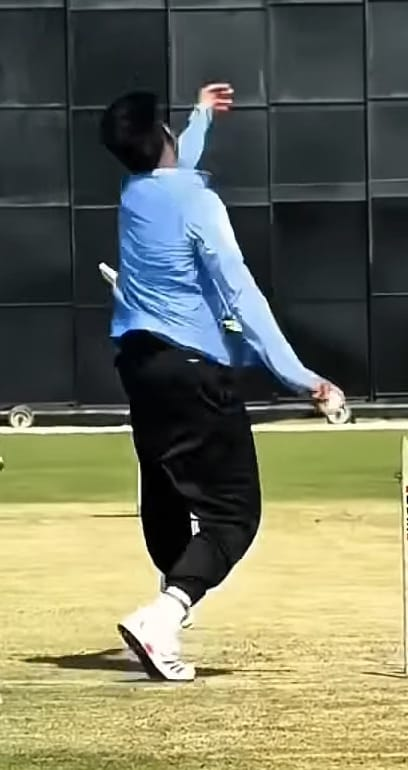
Extension of Non-Bowling Arm :
His non-bowling arm extends at the backfoot contact, which ensures that it drives down in such a manner that it stays extended. This movement of the non-bowling arm promotes faster rotation of the bowling arm, which helps increase the pace of the ball.
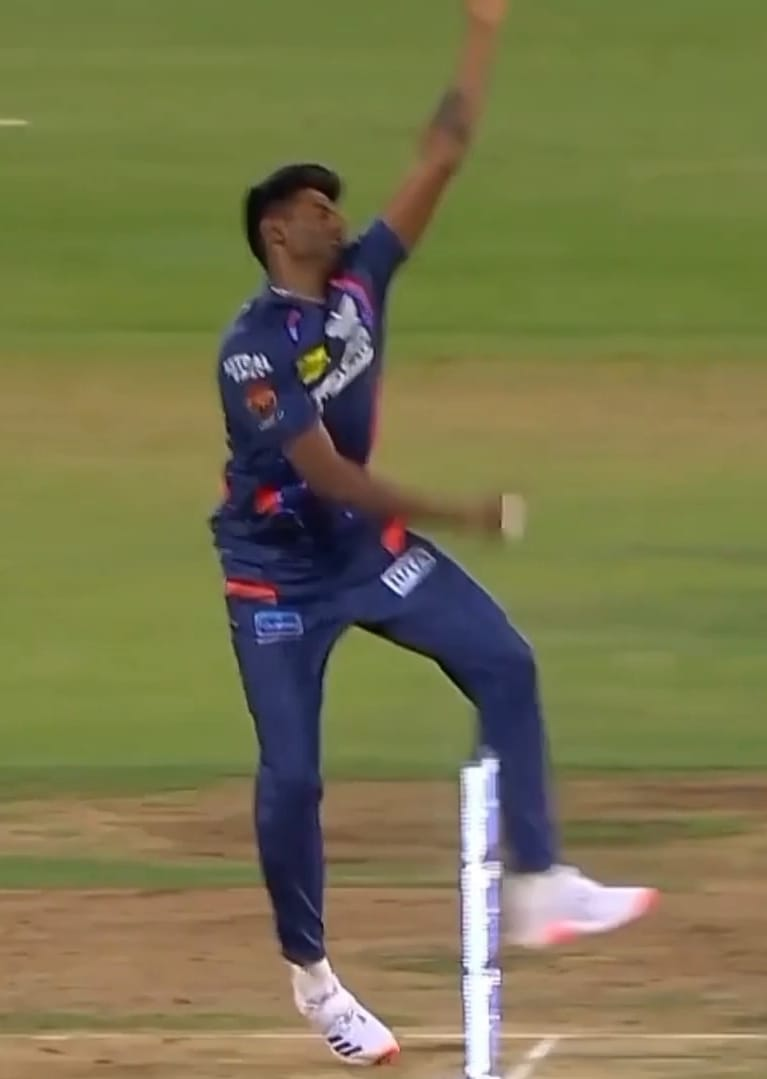
This opening of the non-bowling arm to the right side not only helps him to bowl in the intended area but also prevents his body from falling to his left side.
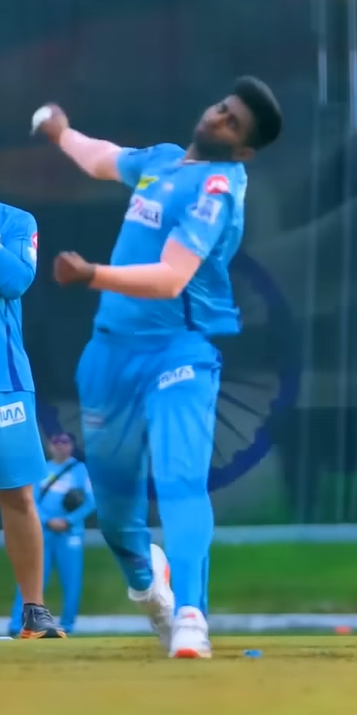
Hip-Shoulder Separation :
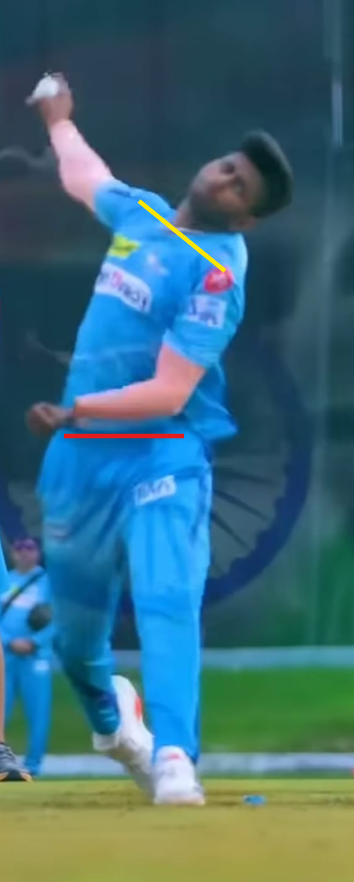
Hip-Shoulder separation is a crucial biomechanical aspect in fast bowling. When both hips start to rotate and face the batter while shoulders remain side on for a fraction longer, storing elastic energy which is ready to release once the shoulder rotates through the bowling arm.
Delayed Bowling Arm :
The bowling arm remains behind the rotation of the lower body and trunk before accelerating rapidly towards release. This delay allows the lower body and trunk to initiate the movement before the bowling arm, creating a more efficient kinetic sequence, rather than generating pace by accelerating the arm too early, he allows the maximum possible momentum and force generated by the lower body to flow through the trunk to the bowling arm. The delayed arm therefore contributes to a longer and more effective acceleration of the bowling arm.
Hyperextension :
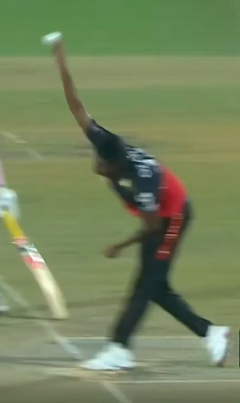
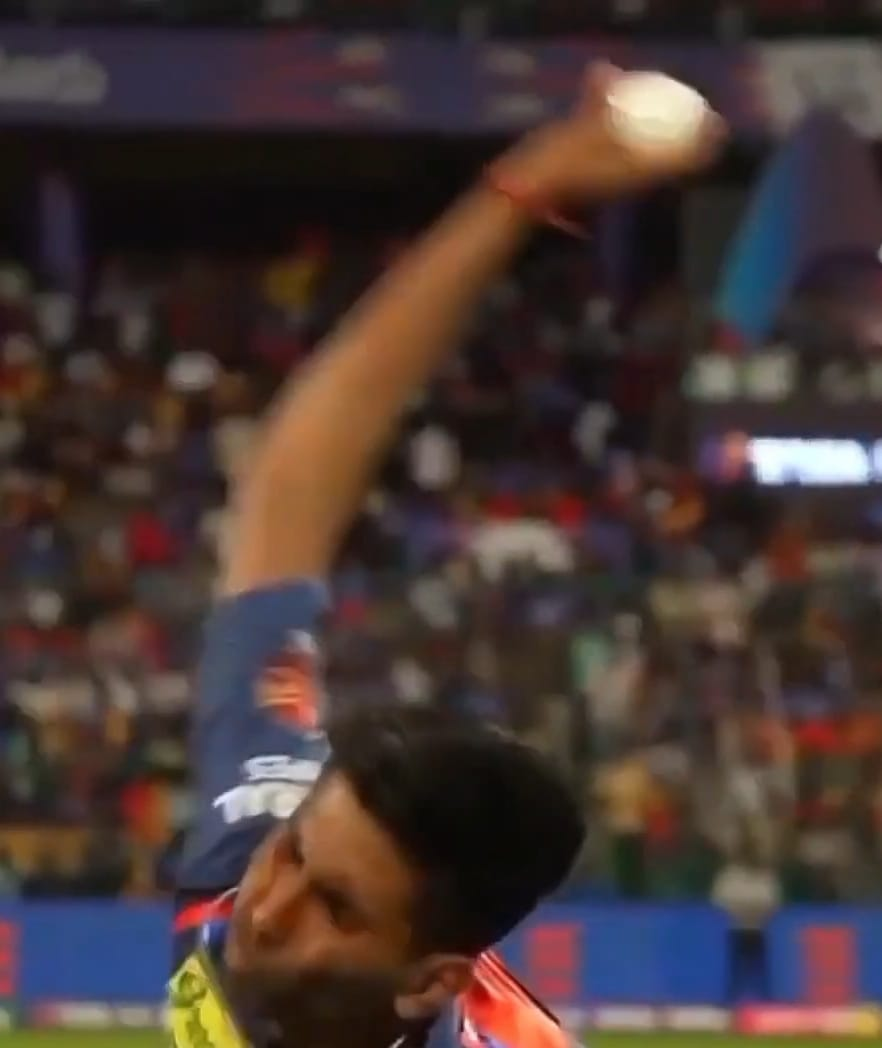
Hyperextension is visible in Mayank’s bowling arm as it moves through the delivery. It may not be the primary source of his pace, but it may complement his arm path and release mechanics by providing additional range through the bowling arm.
Trunk Flexion :
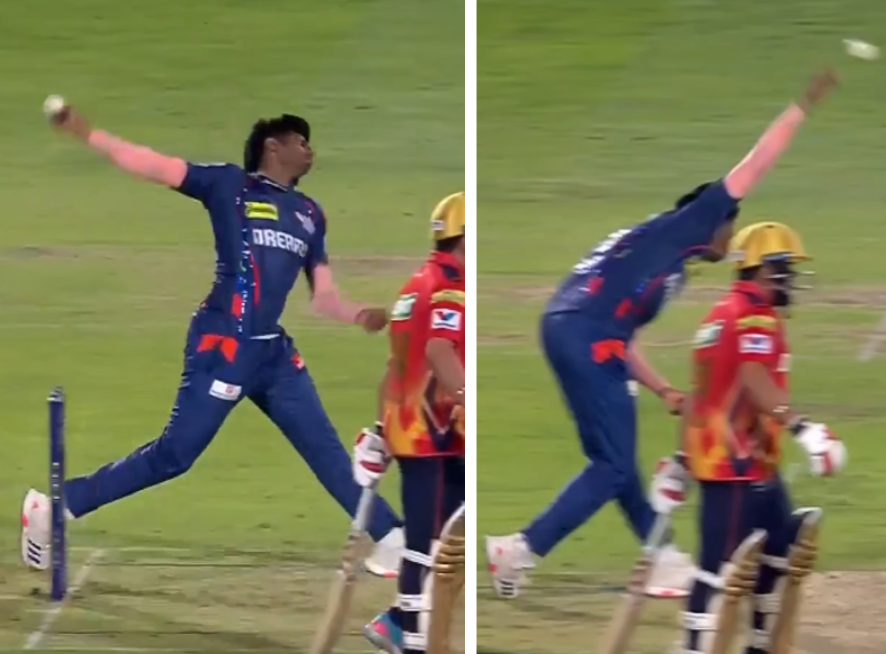
A pronounced forward trunk flexion is observed in his bowling. It allows him to move towards the batter after front foot contact, rather than abruptly stopping the momentum. As his front leg provides a stable base, his trunk moves forwards while the bowling arm accelerates through the release. His back-foot drag is a visible consequence of his continued forward movement. It allows the rear leg to follow the momentum while the front leg provides stability.
So, what makes Mayank Yadav’s express pace look effortless?
The answer lies in the efficiency of his entire kinetic chain. His rhythmic run-up builds momentum progressively, his forward load-up and impulse stride allow him to carry that momentum towards the batter and his shin lead and stiff backfoot contact help preserve it through the transition into delivery.
From there, his hips lead his shoulders, his bowling arm remains delayed, and his non-bowling arm helps control the rotation of his upper body from falling leg side. His trunk flexes forward through release, allowing the momentum to continue towards the batter.
This is the real secret behind the apparent effortlessness. He is not trying to manufacture 150 plus kmph pace with a violent arm action. His action allows momentum, force and rotation to flow through the body in sequence. Each component prepares the next, reducing unnecessary movement and energy leakage. Mayank’s bowling is less about how hard the action looks and more about how efficient it works.