

How has Harry Brook transformed his game against spin?
By Manas Patil
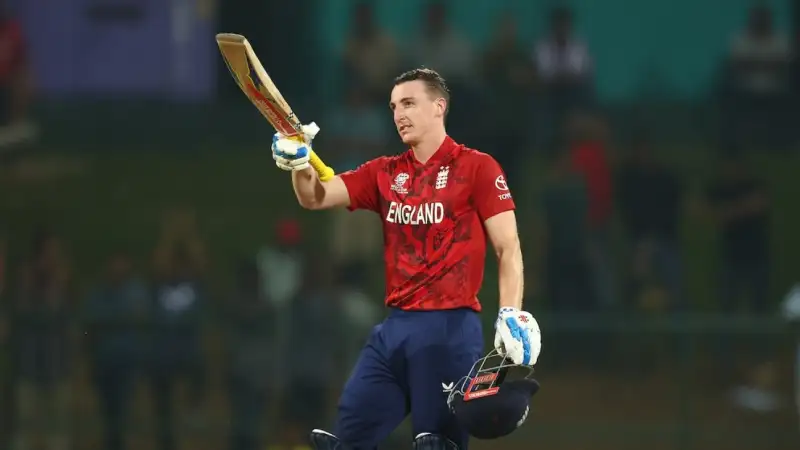
Harry Brook has taken his T20 batting to another level recently. He has scored 690 runs in 18 innings at an average of 53.1 and a strike rate of 189 in T20Is. Before the start of 2026, Brook was ranked 26th in the ICC T20I rankings. As of September 21st, he has climbed to 9th, showing his improved T20I form this year. His form has extended beyond T20Is too, with 255 runs at an average of 31.9 and a strike rate of 181 in The Hundred this year.
His numbers against both pace and spin this year in T20s have been impressive this year. Against pace he has scored at 188 at an average of 39.7 while against spin he has struck at 185 at an average of 52.1.
Brook has long been regarded as a good player of pace bowling but this year what has stood out is his improved game against spin.
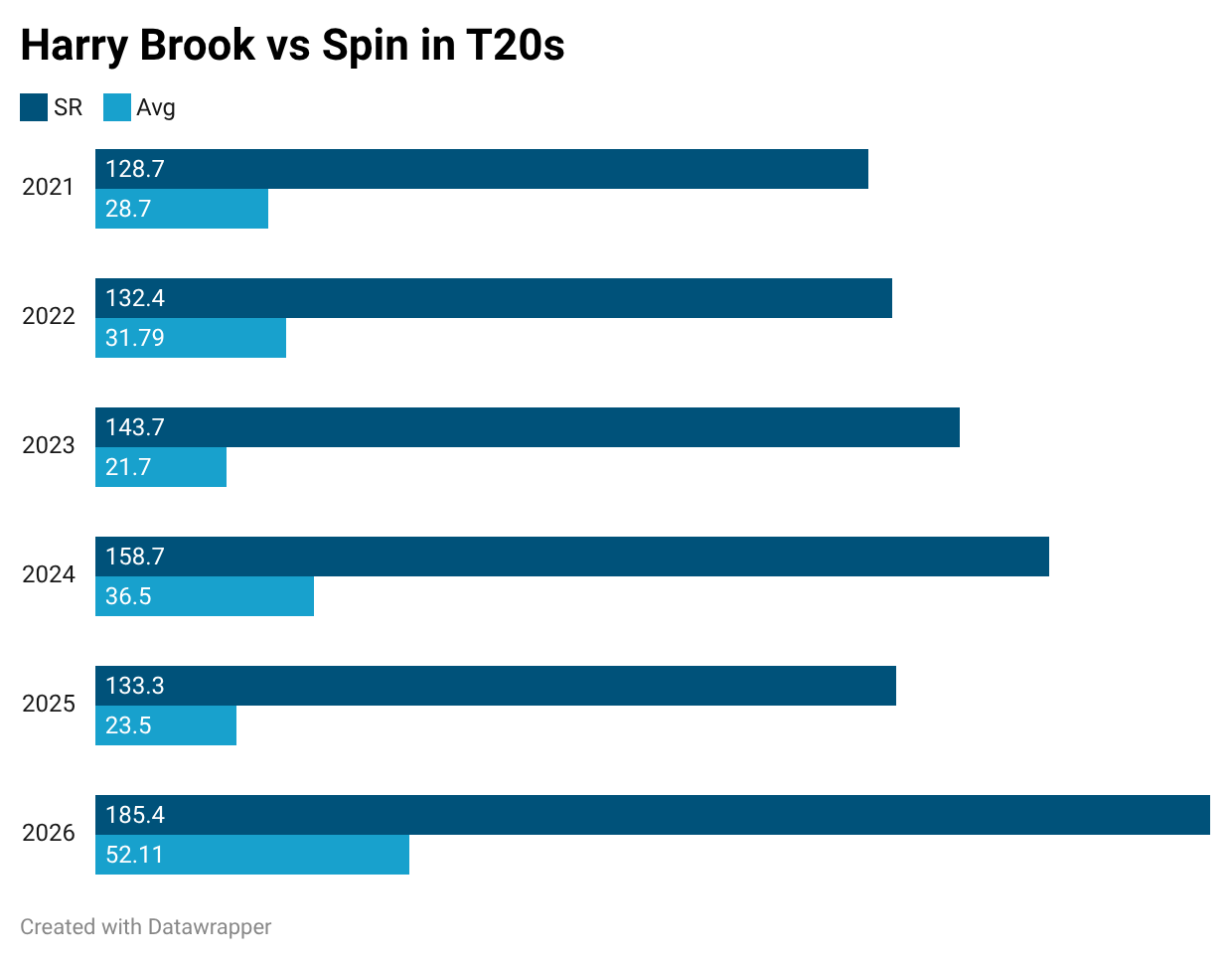
His strike rate and average in the 2021-25 period were 136.3 and 28.5 while since 2026 he’s striking at 185.4 at an average of 52.1. The improvement in his strike rate and average this year against spinners has been one of the key factors for his improved performances in the format this year.
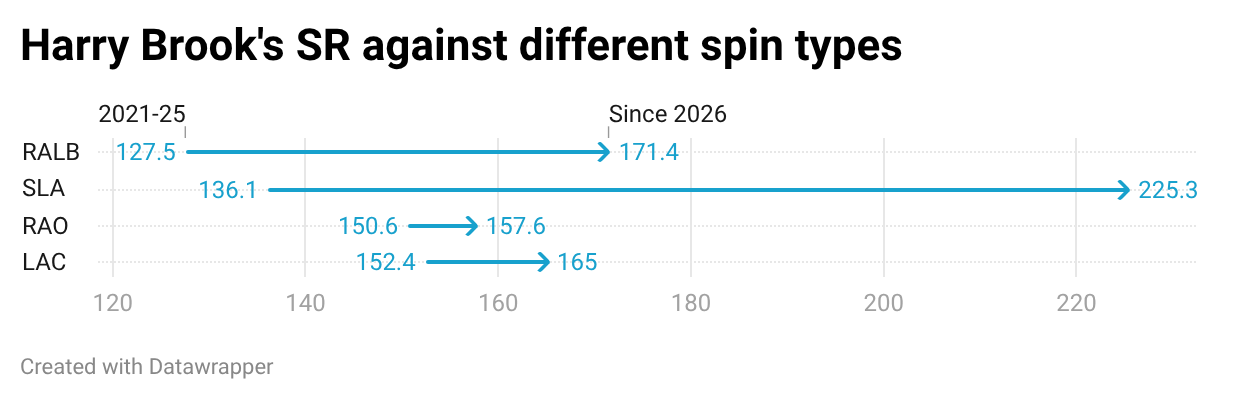
His strike rate has also risen sharply against different spin types compared with the 2021-25 period, particularly against right arm leg-break (127.5 → 171.4) and slow left arm orthodox (136.1 → 225.3).
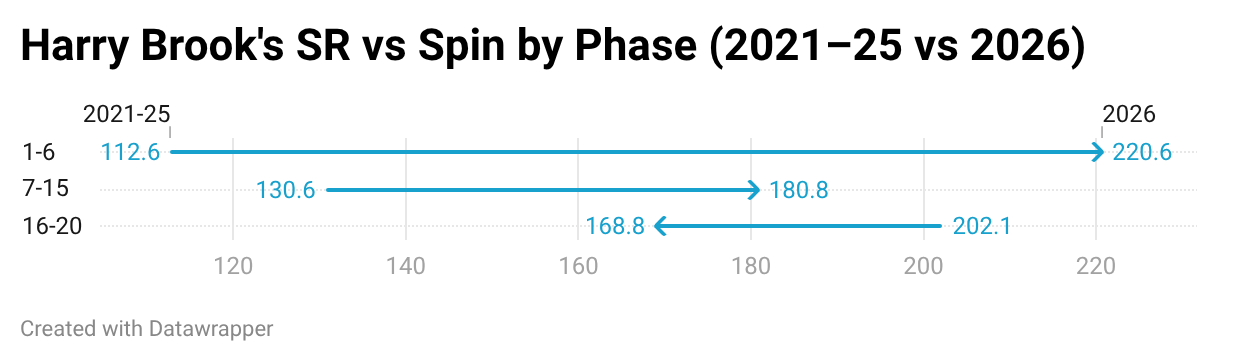
The improvement is evident across phases too, with his strike rate jumping from 112.6 to 220.6 in Powerplay and from 130.6 to 180.6 in the Middle Overs. However, there’s a drop in strike rate in the death overs phase but this is a very small sample size, since he has faced just 16 deliveries in this phase this year.
The Backfoot Shift
Comparing his pitch map against spin across two periods, 2021-25 and since 2026, there’s a noticeable improvement in his strike rate across lengths, particularly against good and short length deliveries.
In the 2021-25 period his strike rate vs spinners on good length and short length was 125 and 150 respectively, while since 2026 it has increased to 169 and 229. The rise in strike rate against good length and short length deliveries points towards a significant improvement in his backfoot game.
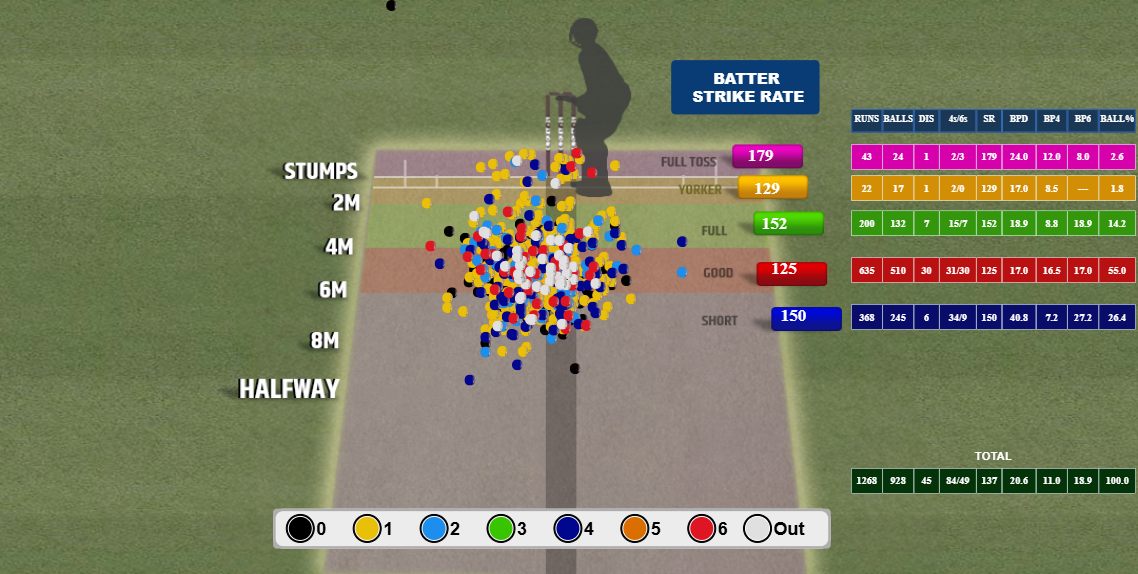
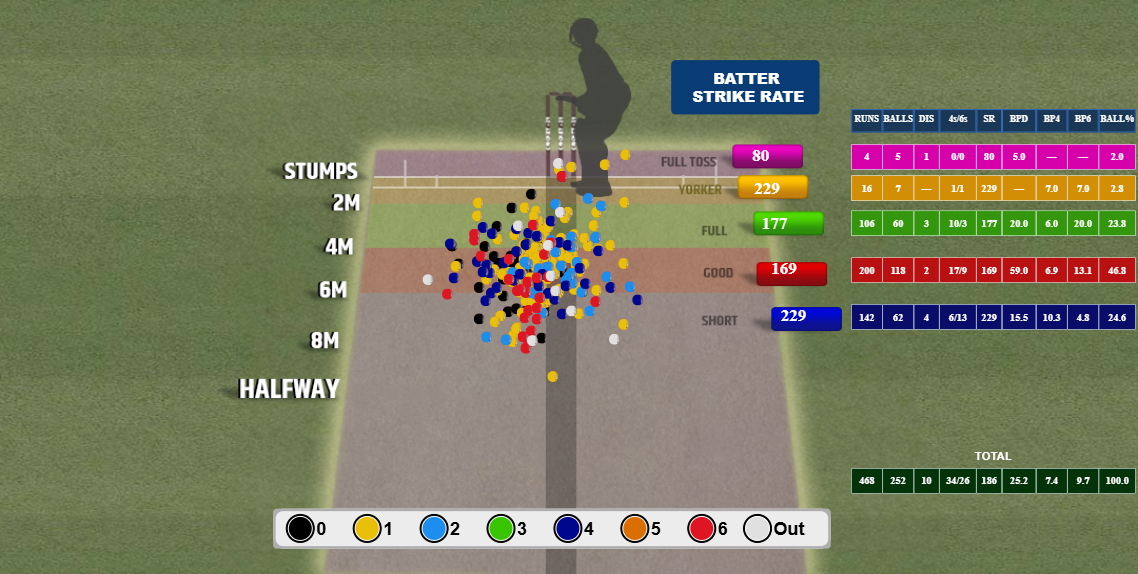
The data also supports this shift, showing that Brook has played more frequently on backfoot this year than during 2021-25, while also scoring a higher boundary percentage from his backfoot shots.
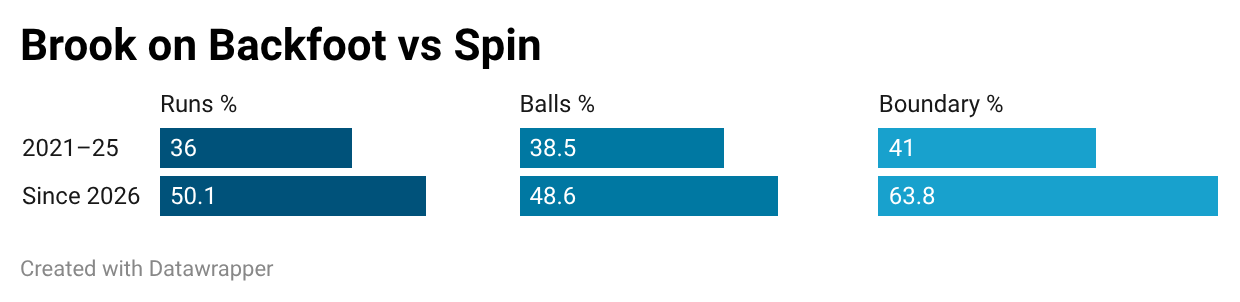
This increased backfoot play probably displays his improved ability of picking the length early, while the increase in boundary percentage points towards the improvement in his hitting ability on backfoot strokes. The question then is what exactly has changed in his backfoot game?
Decoding Brook’s Backfoot Game vs Spin
To understand the shift, we’ll also look into his poor front foot play vs spin. During 2021-25, Brook used to play more deliveries off the front foot than the backfoot and as a result his false shot and dismissal percentage were higher on the front foot.
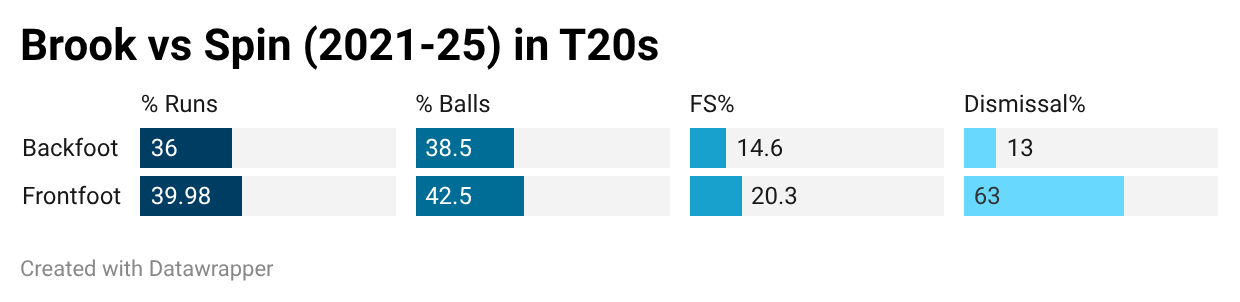
Since 2026, the balance has shifted towards backfoot, scoring more than 50% of his runs through it against spinners. His most productive shot against spin was the pull shot, accounting for 20.5% of his runs against spin.
The Backfoot Pull Shot: A Key Part of the Shift
A pull shot against spin is generally played off the backfoot, with back leg moving across and front leg clearing out in sync to create room for the bat path while playing this shot.
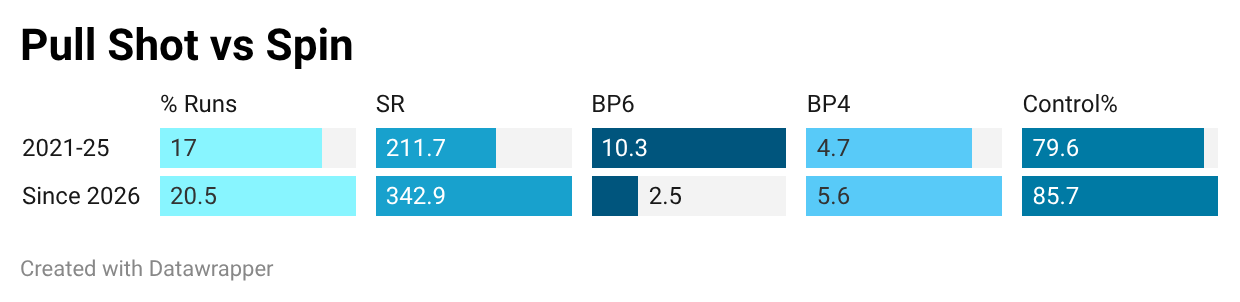
Comparing Brook’s pull shot from this year with previous seasons shows that he is playing the shot more frequently and with better control. His balls-per-six figure has also fallen sharply, highlighting his improved ability to clear the fence while playing the pull shot. But the question is how did this happen?
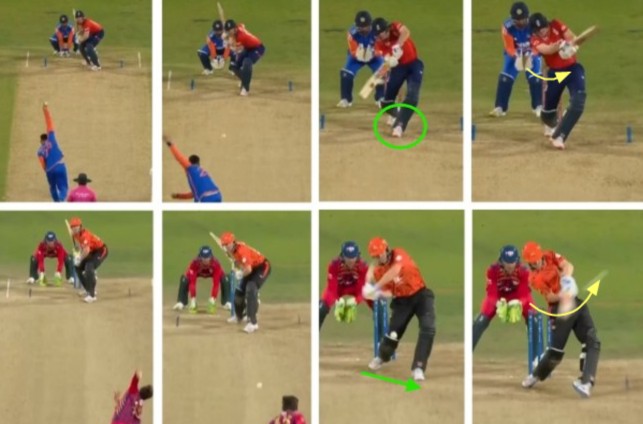
A frame-by-frame comparison with his 2025 technique helps explain why he struggled to execute the shot effectively.
Keeping his stance (frame 1) aside for this discussion, he picks up the length in frame 2 and decides to go for a backfoot pull. Frame 3 is the key to understanding why he found it difficult to clear the fence with this shot. As highlighted, Brook struggled to clear his front leg till 2025. This not only limited his ability to generate power through his hips but also restricted the smooth downswing and upswing of the bat (frame 4) making it harder to generate the elevation required to clear the fence.
Watching Brook against spin this year, it felt like he was setting himself up to play the pull shot whenever the length allowed for it. But an improved pull shot alone cannot explain the reason for his success against spin, other technical changes must have contributed to it as well.
What Changed in Brook’s Technique?
A Better Aligned and Upright Stance
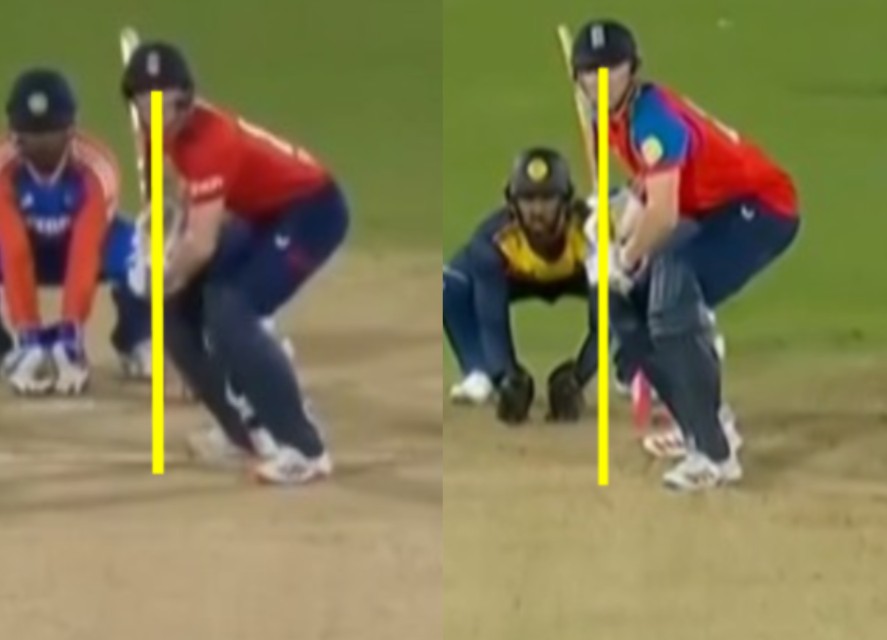
Comparing his stance during the Ind vs Eng T20I series in 2025 with the Eng vs Sl T20I series in 2026, Brook appears better aligned and slightly more upright this year, where he looks more balanced at the crease. One of the reasons for his inability to clear the front leg while playing the pull shot was his over-crouched stance which left his head too far ahead of his toes.
This alignment forced him to press forward and across with his front leg resulting in a greater tendency to play deliveries off the front foot. Consequently, 63% of his dismissals during this period came while playing off the front foot.
Early Front Press
Comparing the timing of his front press between the Ind vs Eng T20I series in 2025 with the SL vs Eng series in 2026 reveals a clear difference. In the 2025 series, he finishes his front press when the ball is about to pitch, while in the 2026 series we see an early press, just before the bowler’s release.
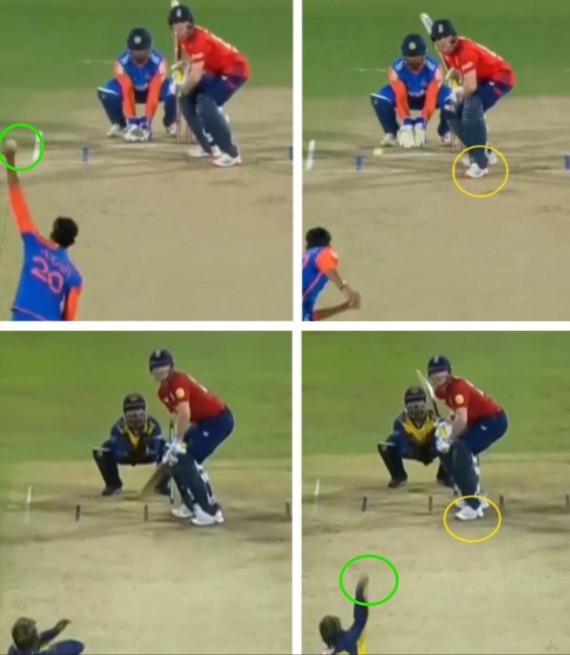
This earlier press combined with his improved alignment, gives Brook more time to read the length and move quickly into backfoot strokes, something that can be compromised when the press is delayed.
This improvement in Harry Brook’s game against spin appears to be more than just a rise in form. His increased use of backfoot play has given him a more effective way of attacking spinners. The improvement in pull shot, coupled with a better aligned and upright stance, helps him to clear his front leg and generate more power and elevation. An early press gives him more time to pick the length and move quickly onto the backfoot. Together, these technical adjustments have helped him to dominate against spin this year.